A non-directional beacon transmits a continuous signal that an aircraft's automatic
direction finder can home on. Offshore, that is how a helicopter finds a platform in poor
visibility, so the beacon is a piece of safety infrastructure and the question that matters is
not what it does but whether it is still doing it correctly.
Nautel have been in this specific business a long time - they introduced the world's first
totally solid-state high power radio beacon in 1970 - and the Vector Series is built around one
insight about how NDB coverage actually degrades. The beacon's radiated field strength depends
on the current in the antenna, and that current changes with the antenna's environment: salt
builds up on the insulators, ground plane resistance shifts. The transmitter is still working,
its output power is still nominal, and yet the usable range has quietly shrunk.
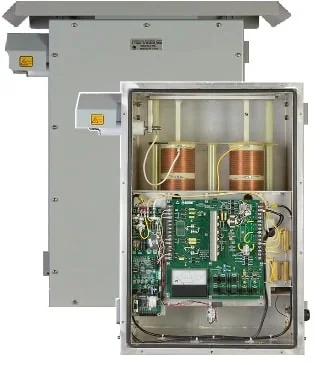
The Vector system addresses that directly. The transmitter and the ATU communicate over a
serial data bus, which lets the transmitter monitor antenna current and - as a user-enabled
feature - automatically adjust its output power to keep that current constant, holding the
radiated field strength steady. Nautel state plainly that this feature is unique to their NDB
systems. Alongside it the ATU performs automatic resistance matching. The combination means
coverage is maintained rather than assumed, which is the whole point of a patented approach to
what looks like a solved problem.
The D in the catalogue designation is the dual configuration: main and standby transmitters
with automatic changeover, so a transmitter fault takes the standby on air rather than taking
the beacon off it. For a helideck beacon that is usually the right specification, because the
alternative is an unserviceable approach aid and a visit offshore before it can be restored.
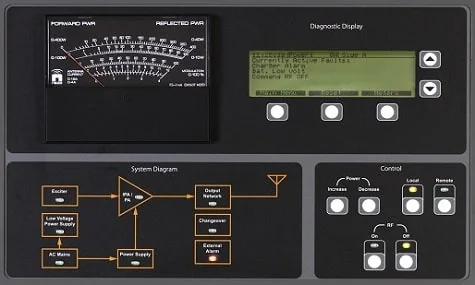
Everything else about the design is aimed at not having to go there. There is extensive
automatic fault monitoring with a 256-event log, so a fault that has cleared can still be
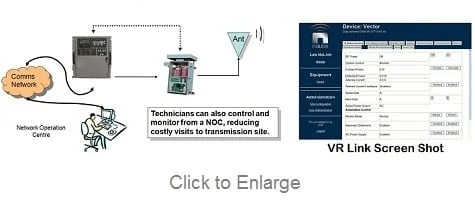
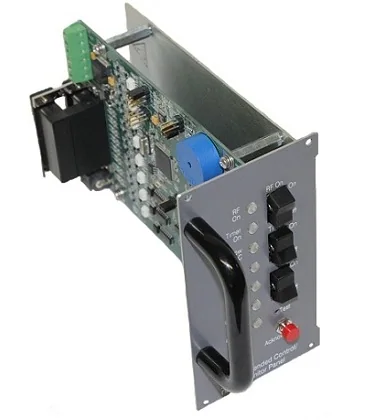
diagnosed. The optional VR-Link remote control and monitoring unit hosts a web page reachable
from any standard browser, with no special software on the remote PC, over RS-232, RS-422,
leased line, dial-up, radio or GSM/GPRS modem, or Ethernet. Remote control of the ATU is
included specifically to limit worker exposure to strong RF fields, in keeping with Safety
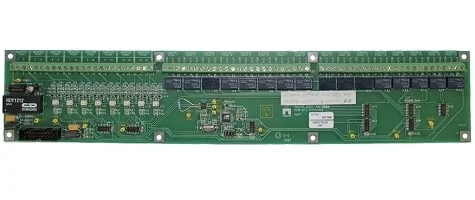
Code 6 and IEEE C95.1-1999. An optional Site Interface board adds 16 optically isolated inputs
and 16 dry relay contact outputs, bringing smoke, fire and intrusion sensors at the beacon
site into the same remote monitoring.
The exciter is synthesized, using DDS to produce a highly stable RF drive at the operating
frequency, and there is a graphical user interface for maintenance and troubleshooting. The
transmitter is compliant with ICAO Annex 10, Volume 1, Part 1, Section 3.4 and CE certified.
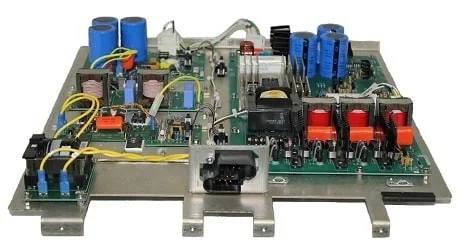
Efficiency is 70 percent or better, achieved with Class D RF amplification and pulse duration
modulation - which on an unmanned or solar-powered site is the figure that determines the size
of everything else.

 1 / 5